
Ask a packaging supplier what “FSC certified” means and you will get one of two answers. A label description: our boards carry the FSC mark, the paper comes from responsibly managed forests. Or a certificate number, checkable in a public database. Both are true, but they describe different halves of the system, and the difference decides what the label may claim about your box.
FSC stands for the Forest Stewardship Council, a non-profit that writes the rules for how forest fibre is harvested and how it is traced through the mills, converters and printers that turn it into packaging. FSC certified packaging is a box whose paper fibre is covered by one of those rules, with a matching mark on it. What follows is which rule applies to your box, what the certificate number proves, and where the label earns its money.
What the FSC actually certifies
Forests and supply chains get certified separately, and a finished box usually depends on both.
Forest management certification is the harder one to get and the one most people picture. It applies to the land itself. An auditor checks how the forest is harvested: is the logging legal, are biodiversity and water protected, does replanting keep pace with felling? A forest that passes carries a forest management certificate. Its fibre can then be sold as FSC virgin material.
Chain of custody is the part that touches your box, and it is about paperwork, not forests. Every mill, paper trader, board converter and box maker that wants to sell FSC material must hold its own chain of custody certificate: certified fibre must stay tracked and separate from non-certified fibre at every handoff. A mill blending FSC pulp with ordinary pulp documents the ratio. A box factory records how much board went in and what came out. The number you see quoted on a supplier’s website is issued by an accredited body, and it is what lets that company make FSC claims.
In practice you are almost always buying through the second system. The forest may be far away, but the chain of custody is the paper trail connecting your box to it.
The three FSC labels on a finished box
The same box structure can carry three different FSC marks, and they are not interchangeable. The label tells you what the fibre is, not how good the box is.
| Label | What the fibre is | Typical specification |
|---|---|---|
| FSC 100 | Virgin fibre from forest-management-certified forests only | Hero packaging where the certified-forest story is the claim |
| FSC Mix | Certified virgin fibre plus recycled fibre, plus a controlled portion | Everyday packaging where a documented story matters |
| FSC Recycled | Recycled fibre only | Packaging whose claim is recycled content, not forest management |
The Mix label does the most work in the market. Its standard sets a minimum share of certified fibre, 30 per cent in most markets, and the balance must come from controlled sources: paper that is not FSC certified but documented as free from disputed origins. That controlled-wood element is what buyers miss most often. A certificate does not tell you the exact split in your board, so if the split matters, write it into the specification.
The Recycled label is for claims about keeping paper in circulation, not about how new forests are run. It does not mean the box is compostable, and it says nothing about the film or the glue in it. Each label makes one specific promise. Pick the one you want, and hold the supplier to that wording.
What a chain of custody number proves, and what it does not
Suppliers often print a certificate number on a website or quotation. The one on Xinpeng’s own rigid box page, COC FSC No. SGSHK-COC-330577, follows the usual pattern: certification body, regional code, CoC marker, serial number. The site’s description is fair: it guarantees the wood used to make the paper products comes from responsibly managed forestry.
The precision matters. A chain of custody certificate proves three things and stops there. The holder has been audited. It has documented procedures for keeping certified fibre tracked and separate. And a specific material it handles can be claimed as FSC. Everything beyond that is a different conversation.
It does not say what share of your particular order is certified fibre. It does not cover the inks, coatings, adhesives or window film, because none of those are paper. It does not say the box is compostable, food safe, or recyclable in any specific municipal stream. And it does not travel. A certificate belongs to the company that holds it, so it is no substitute for confirming the particular board in your spec is certified stock.
The honest reading is that the number is a starting point, not a finish line. The rest you specify and verify yourself.
How to verify a supplier’s FSC claim in five minutes
Verification is cheap and fast.
- Ask for the chain of custody certificate number, not just the FSC mark. A mark without a number is decoration.
- Look the company up in FSC’s public database of certified companies, where the entry shows the number, the scope, and the expiry date.
- Check that the scope matches what you are buying. A certificate covering printing but not board conversion tells you less than one covering both.
- Match the label type on your spec to the certificate. If the spec says FSC 100 and the certificate covers FSC Mix, only the Mix label can appear on the box.
Two traps are common enough to name. A certificate that is current but narrow, covering the supplier’s own printing shop while the board arrives from a mill with its own paperwork. Both links need to hold for the claim to hold end to end. And a certificate that expired quietly: databases show dates, quotation templates often do not. None of this costs anything. A label type discovered at the proof stage is a design change, and a design change is a delay.
When FSC is worth specifying, and when to skip it
Certified fibre carries a premium. Whether it is worth it depends on what the packaging needs to say.
Specify FSC when the claim is part of the brand. If packaging provenance is a real purchase driver in your market, or a contract asks for certified fibre, the label is doing commercial work and the premium is a cost of doing business, not an optional add-on. If the visible story of the brand is natural materials, FSC 100 on the outer board is the strongest version of that story.
Skip or downgrade it when the claim is not one you will actually make. A box that says “recycled” promises something different from one that says “FSC.” Paying for a forest-management story that will never be printed is a premium with no return. On inner components, where the fibre is never seen and no claim will appear, ordinary stock does the same job for less. And if the real goal is cutting waste, a smaller box out-earns a certified label on an oversized one.
The sequencing rule: decide the claim first, in the exact words it will appear in, then buy the label that matches it. Do it in the other order and you end up with a box certified for a story the marketing team never told.
What FSC does not cover
The label is about fibre, so the rest of the box sits outside its rules. That is where well-meaning packaging goes wrong.
Inks and coatings are the most common gap. A box can carry a clean FSC mark and be printed with solvent inks under a plastic film, and nothing in the certificate is violated. If the surface treatment matters, water-based inks and water-based coatings are the options to ask for. They are specification items, not FSC items. Windows, glue tabs, ribbons, foam or plastic inserts: none of it is covered. A film window is the most common way a recycling story falls apart.
Recycled content is its own label. Compostability belongs to different standards entirely, and food safety is a third conversation. FSC is a good answer to one question and not an answer to the other four. The failure mode is treating it as a catch-all: one mark printed, the whole sustainability page assumed licensed.
Putting FSC into a packaging specification
The practical version fits in three lines on a spec sheet.
Name the label type per component: outer board FSC Mix, inner tray recycled, insert kraft. Name the inks and coating. Carry the supplier’s certificate number on the spec so the next auditor or retailer can check it directly.
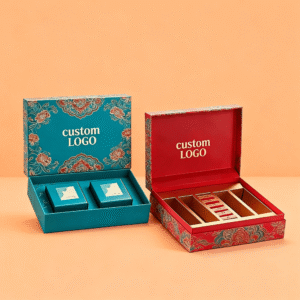
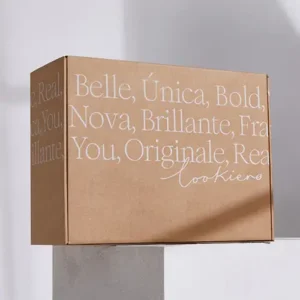
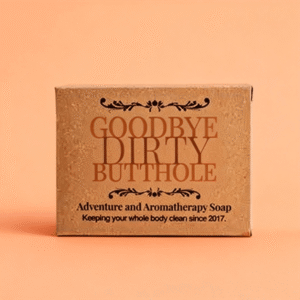
For the board itself, a kraft stock made from a blend of virgin and recycled pulp is the material most often specified under these labels, and it pairs naturally with tuck boxes and mailers, where the unbleached surface does half the visual work. In a rigid gift box, the certified stock is the base board under the cover, and the finishes on top, foil, embossing, soft-touch coating, are separate line items that do not inherit the certificate.
Start from the claim, verify the number, write the split into the spec. All of it before the first sample, all of it cheaper than fixing a label after the boxes are printed. The styles this applies to are on the product boxes page, and most certified-fibre specifications start with the kraft box range.
Questions people ask about FSC certified packaging
What does FSC stand for?
The Forest Stewardship Council, a non-profit that writes the standards for forest management and chain of custody, and whose mark appears on certified products.
Does an FSC label mean the box is eco-friendly?
It means the paper fibre has a documented, audited origin, which is one specific part of being eco-friendly. It says nothing about the inks, coatings, adhesives or plastic components, so read it as one claim, not a verdict on the whole box.
What is the difference between FSC 100 and FSC Mix?
FSC 100 is virgin fibre entirely from certified forests. FSC Mix blends certified fibre with recycled fibre and controlled, non-certified sources, with a standard minimum share of certified content. Mix is the more common choice and typically the cheaper one.
How do I check a supplier’s FSC certificate?
Ask for the chain of custody number and look the company up in FSC’s public database of certified companies. Confirm the certificate is current, that its scope covers the material you are buying, and that the label type on your spec matches what the certificate allows.