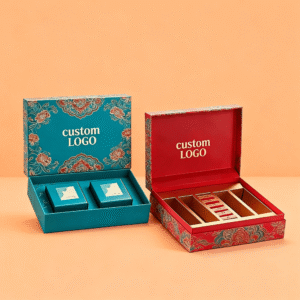

Most businesses attack packaging cost in the same place, which is the unit price on the quote. That is the last lever rather than the first. By the time a number reaches you, the expensive decisions have already been made: the size of the box, how many sides carry print, how many finishing steps the design needs, how it ships and how much space it occupies before anyone uses it.
Two boxes can hold the same product and differ enormously in cost without either one looking better on the shelf. The useful question is not who will quote lower. It is which of your own decisions is generating the cost, because that is where the money actually sits.
The price you negotiate is the last lever
A packaging quote is a stack of components. Board or paperboard, billed by area. Plates and printing, billed by the number of passes and the number of sides. Each finishing operation, again by pass, each with its own setup. A die for the cut and crease. Assembly labour, if the box is delivered made up. Then packing and freight, which depend on volume and weight rather than on how premium the box looks.
Negotiating the unit price mostly moves labour and margin, and margin has a floor. The components above it are set by your specification and your order profile, which means they are yours to change. A buyer who arrives with a complete specification and no flexibility is negotiating over a small slice of the total. A buyer who understands which parts of the specification are expensive is negotiating over the whole thing.
The practical consequence is that a cost conversation should start a step earlier than most people start it, with the drawings and the shipping plan rather than with the price.
Board is billed by area, so oversized boxes waste it twice
Paperboard is sold by area and weight, so a box that is slightly too large costs more material for no benefit. It also costs more to ship, because carriers charge on a dimensional basis once a parcel passes a certain size relative to its weight. Oversizing therefore shows up in two invoices rather than one.
The common cause is designing around the worst-case product rather than the actual one. A box with generous internal clearance needs void fill to stop the product moving, and that fill is another purchased item with its own cost and its own handling time. Taking a few millimetres out of a cavity often removes both the material and the fill.
There is a limit, and it is not worth crossing. A box that is too tight deforms, crushes corners in transit and can damage the product, and the saving disappears in replacements. The target is the smallest cavity the product fits into with the protection it genuinely needs, which for most goods is less generous than the first sketch suggests.
Every additional pass has its own setup
Printing is not one operation. Each printed side is a separate run, which is why the specification asks whether print goes outside only, inside only, or both. Inside print on a gift box earns its cost because it lands at the moment of opening. Inside print on a shipping carton that nobody photographs is money spent on a surface that gets cut open and thrown away.
Finishing compounds this. Foil stamping, embossing, debossing, spot UV, a die-cut window, lamination and coating are each a distinct production step with its own setup and its own queue. A design that combines foil, emboss and spot UV can carry three finishing passes on top of the print. Removing one of them frequently saves more than any board-price negotiation, and the customer rarely notices.
Where a design needs a light colour on brown or coloured stock, the job also needs an opaque white underlay printed first, which is another pass. Designing so the board colour does the work instead is one of the few changes that reduces cost and usually improves the look at the same time.
Structure decides more of the cost than the material grade
Businesses often try to save money by downgrading the board while keeping the structure. The structure is usually the bigger line item.
A rigid box is built around a thick grey chipboard core with a printed wrap, which means two material streams plus wrapping labour. A folding carton is a single die-cut sheet that folds flat. A corrugated mailer is built for transit and folds and locks without glue. Using a rigid box for a product that then ships inside a plain outer carton means paying for premium presentation twice and protecting it once.
Delivery format matters just as much. Rigid boxes can be supplied assembled or flat-folded, and the flat version shifts assembly to the customer while cutting storage and freight volume substantially. Mailers are normally flat-shipped and assembled on packing. If your warehouse has space and your freight is expensive, flat is the cheaper shape. If your labour is the constraint, assembled is worth the freight.
Tooling is a fixed cost you either amortise or waste
Every unique size and every unique shape needs its own cutting die. That cost is fixed, which means it is cheap per unit across a large run and painful across a small one. It is also repeated in full for every variation you add.
This is where standardising a range pays. A family of boxes that shares one board thickness, one closure style and where possible one die footprint amortises the setup across everything you sell instead of charging it to each product once. Fewer sizes also simplify purchasing, storage and reordering, which are real costs even when they do not appear on a quote.
The trap is forcing a product into a box that does not fit in order to reuse a die. A compromise size produces a box that needs extra void fill, protects badly, or looks wrong for the product, and you have traded a one-time tooling saving for a permanent per-unit penalty.
Landed cost includes the space the box takes up
A box that is cheap per unit can still be the expensive choice once it moves. Freight is charged on weight and volume, so a design that nests badly or arrives assembled can multiply the space it occupies. Storage is charged the same way, and packaging that arrives made up consumes warehouse volume for as long as it sits there.
The shipping mode amplifies this. Air freight punishes volume severely, so flat-packed and lightweight wins clearly. Sea freight is more forgiving on volume but rewards planning, since the saving only materialises if the order is placed early enough to travel that way.
It is worth calculating a landed cost per unit rather than a purchase price per unit, including inbound freight, storage and the labour to assemble and pack. Plenty of specifications that look competitive on the quote lose on that comparison, and the reverse is also true. Recheck the figure whenever freight rates move, because a design that made sense on one rate can quietly stop making sense on the next.
Where a cheaper box costs more
Some reductions are genuinely free. Others move cost somewhere less visible.
Thinner board is the classic example. It saves material and then produces dented corners, a lid that will not stay square and a box that feels inexpensive in the hand. On a product sold on perceived quality, that is a permanent discount on the brand. Removing an insert to save a component produces a product that shifts in transit, and damage claims cost more than the insert.
The test that resolves most of these arguments is what happens to the box after it is opened. A shipping carton is cut and discarded within minutes, so there is no reason to print its inside or foil its lid. A gift box is kept, photographed and sometimes reused, and the surfaces a customer touches are exactly where cheapening shows. Cost reduction should target the first category and avoid the second. Any saving you can photograph as a flaw is not a saving, whichever line of the quote it came from.
What to put in the brief to get a real reduction
Suppliers can only optimise what they can see, so the brief determines the answer you get.
Give the product dimensions and weight, how the box ships and by which mode, the annual volume for each size, and which elements are fixed brand requirements against which are negotiable. Ask for two options at different cost points and, critically, ask what drives the difference between them. A supplier who can explain that the second finishing pass is a third of the gap is telling you where to negotiate.
Ask for the cost broken down by component rather than as a single unit price, and ask which single change would save the most. Then check the answer against the physical sample rather than the specification sheet, because board thickness and coating feel different in the hand than they read on paper. The mailer box range shows how structure and flat-shipping change both protection and cube, the tuck box styles cover the folding cartons most retail products use, and the rigid box options make clear what the premium format actually costs you in materials and assembly.
Questions people ask about packaging cost
Does a bigger order always lower the unit cost?
It lowers the fixed part, because dies, plates and setups are spread across more units. It does not automatically lower material or freight, and it adds storage and cash-flow risk. Past a point the curve flattens, and ordering more than you can sell in a reasonable time is a cost rather than a saving.
Can I reduce cost without changing the design?
Often yes. Right-sizing the cavity, removing inside print on cartons that get discarded, consolidating two finishing passes into one, and switching to flat shipping all reduce cost without touching what the customer sees. Design changes give bigger savings but need a new die and a new proof.
Is a cheaper box always a worse box?
No. Plenty of expensive boxes spend money on surfaces nobody looks at. A plain corrugated mailer with one ink mark is both cheaper and better suited to transit than a foil-stamped carton. The distinction is whether the spend lands where the customer actually is.