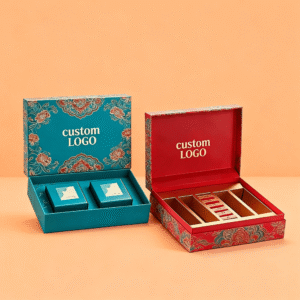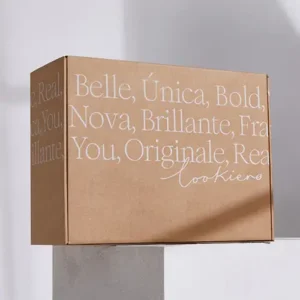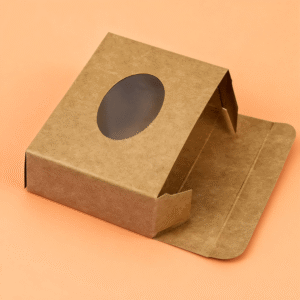

Send out a custom box request and the reply usually carries one of two words you are expected to understand: OEM or ODM. Most buyers do not, and the wrong assumption costs real money later. Here is the direct version. OEM means the factory manufactures to your design. You supply the structure, the dieline, the materials and the artwork, and the factory’s job is to make exactly that at the agreed spec. ODM runs the other way. The factory already has the box designed as a style it makes for multiple brands, and your job is to put your brand on it: size, board, color, print, and a few structural tweaks. The cost, the time, the control and the risk all follow from that one difference in who does the designing.
OEM means the factory builds the box you designed
Under an OEM order, the design decisions are yours and the factory holds you to them, including the structure itself, not only the print. The dimensions, the closure, the board, the finishing stack, and the dieline that defines all of it. If your product has an unusual shape, or the opening sequence matters to how the brand lands, this is the model that gets you there, because nothing about the box is constrained by a catalog the factory already sells.
The flip side is that you carry the design load. Every specification has to exist before production starts, and every one is a decision point that can slip. The factory is not there to rescue a half-formed brief; it is there to make, cleanly and at scale, what you have already decided.
What you actually bring to an OEM order
Practically, the inputs are your product’s dimensions and weight, a structure or a brief clear enough to design from, artwork, the board and thickness you want, and the finishing list. Without a dieline, a supplier’s design team creates one, the difference between bringing a blueprint and a description. At iPackBox that step comes as free design support, with 3D design services for structures that are hard to picture on paper.
ODM means the factory designs and you brand it
ODM starts from a finished structure. The factory has already designed, prototyped, and usually die-cut the style, and offers it to any brand that wants it. What you bring is not a structure but a brand: your colors, your logo, your copy, and choices inside a fixed set of options, typically the size within a range, the board or liner, and which finishing effects get applied. The design work is already paid for and amortized across every client that runs the style, which is why the ODM quote starts lower.
The price of that convenience is sameness. The structure on your shelf is the same structure the factory sells to other customers in other categories, and if two brands pick the same style at the same size, the only thing separating their boxes is the ink. ODM is the right call when the box is a container doing a job, protecting the product and carrying the label, rather than a prop doing brand work in the customer’s hands.
Why supplier answers blur the line
Ask five suppliers how they handle custom work and you get back a mix of terms: custom, private label, semi-custom, full customization, sometimes OEM and ODM used as if interchangeable. The distinction only matters once you know which decisions are fixed and which are open. Private label on one of the factory’s own styles is ODM with a different name. Calling everything custom may still mean only the surface print gets touched.
The cleanest way to tell the mode you are actually in is to ask four things: who decides the structure, who pays for and owns the die, can the structure change after the first order, and is the style exclusive to you or shared across clients. A factory running true OEM answers all four with you. The supplier selection guide works on the same premise, that the questions answered before production are worth more than the price on the first quote.
Where the money actually goes
Both models spend money in different places, and the difference shows up in the first order more than in the tenth. OEM spends up front: the structure gets designed, the dieline checked, a die cut, plates made, and sampling runs until something on your side approves it. ODM spends less up front because the structure, the die and the proofing cycle largely already exist for that style. You pay for your surface, not for the box’s engineering.
The mistake to avoid is spending on structure nobody will ever see. If your box rides inside a plain poly mailer and the customer never touches it, a custom structure is budget gone into a part of the product the market cannot feel; spend where the customer actually looks and touches, the outer face, the print, the finish. The reverse mistake is under-spending where it counts, a cheap standard structure on a product whose unboxing is the entire reason it gets shared. Engineer the box in proportion to the role it plays.
Timeline and sampling, the part that moves your launch date
Time is the second axis, and it moves the same way as cost. An OEM order travels a longer road before a single production unit exists: design, dieline, a prototype or proof, your sign-off, then production, and each gate waits on a person on your side. The production timeline article makes the point that most delay in a packaging order is not printing, it is waiting for something to be approved. ODM skips the longest stretch of that road because the structure is settled; your gate is the surface approval, one round instead of several.
A typical sequence runs consultation, design preparation, a physical prototype or digital proof, production, then a final quality audit before delivery. That is the order iPackBox runs, and the prototype step is the one worth protecting, because it is the last cheap place to catch a design problem. Actual lead times vary by style and level of customization, so confirm the date for your specific box with the supplier rather than planning around any generic range.
Which model fits your brand
Strip it to the decision and four questions do the work. Is the unboxing part of the product? Gift sets, premium cosmetics, electronics, anything sold partly on the experience of opening it, justify the structure investment of OEM. Do you have design assets and someone to maintain them? OEM without design follow-up is how a good box becomes a stale one after a rebrand. Is there a hard date? A launch that cannot move usually lands on ODM or an existing style, because the critical path is shorter. Will the box be reordered? If yes, the one-time die cost spreads across every subsequent run, and reusing the die removes the tooling step from each reorder, one reason a repeat order moves faster than a first one.
The hybrid route is the one most brands should take. Start with ODM on the style closest to your need, get the product to market, and watch what customers actually do with the box. Then move the winning SKU to an OEM structure built around those findings. You paid ODM prices to learn what the structure should be, instead of paying OEM prices to find out.
How iPackBox runs both models
On the OEM side, the customization is structural and complete. Base stocks run grey chipboard made from recycled paper pulp, duplex board, SBS C1S and C2S paper, and kraft, with paperboard from 11 pt (230 GSM) to 24 pt (460 GSM), rigid stocks up to 1600 GSM, or E and B flute corrugated for mailers. Printing covers offset, digital, flexographic, screen and UV, and the finishing list runs through foil stamping, spot UV, embossing, lamination and soft-touch coating, with foam, cardboard and molded pulp inserts for the inside. The rigid boxes and mailer boxes pages lay out each option in detail.
On the ODM side, the starting point is the existing style library, a tuck box, a kraft box, a flip top, a drawer, with the free design support and 3D design services sitting on top. The documentation is where claims stop being claims, with an FSC chain-of-custody number, SGSHK-COC-330577, listed on the site alongside BSCI and GOTS. If you are ready to compare the two paths for your own product, the quote form takes the specification up front, which is how you get a real answer instead of a template one.
Questions brands ask about OEM and ODM
Four questions come up in nearly every sourcing conversation, so here are the short answers.
Is OEM packaging always more expensive than ODM?
Not on the first order, usually yes on the total. OEM carries design, dieline and one-time die costs that ODM avoids by reusing an existing style, so the ODM quote starts lower. The gap closes as runs repeat, because the OEM die gets reused and its cost spreads across more boxes. The honest comparison is total cost over your expected order history, not the first invoice.
Can one supplier do both OEM and ODM?
Yes, and most custom box factories do, which is why the label alone tells you nothing. Ask who decides the structure and who owns the die. If the answers are you and you, that is OEM. If they are us and us, that is ODM no matter what the sales page calls it. iPackBox runs both as described above.
Can I start with ODM and switch to OEM later?
That is the standard route. Run the existing style, learn what customers actually do with the box, then design the structure around those findings. Keep the dimensions you have already validated so the fit does not have to be re-learned, and carry the lessons, not the habits, into the new design. The switch costs one prototype cycle, cheaper than getting the structure wrong twice.
Who owns the design and the die in each model?
Under OEM, your artwork and your structure are yours from the start, and the die is normally built for your shape, so a later reorder or a change of supplier can reuse it. Under ODM, the base structure belongs to the factory and you own the branding applied to it. That difference decides what you can do when you leave, take your engineering with you, or leave with your logo on someone else’s box.