
Every paper packaging box is built from three layers of decision: the board that gives it structure, the surface treatment that gives it a look and a feel, and whatever goes inside to hold the product. Ask “what materials are used” and most people mean the first one, but the other two change the cost and the recyclability just as much.
Here is the short answer. Paper packaging boxes use paperboard, corrugated board, or rigid board as the base. Folding cartons run from about 11 pt (230 GSM) to 24 pt (460 GSM). Corrugated boxes use E-flute or B-flute. Rigid boxes are built on 800 to 1,600 GSM grey chipboard, duplex board, or kraft board, then wrapped in printed paper, foil, or fabric. On top of that you add a coating or laminate, and often a finishing step like foil stamping or embossing.
What follows is how those materials actually behave, and where the choices stop being cosmetic.
The board is the part that decides everything else
Board is graded two different ways and the two get used interchangeably, which causes a lot of confusion. Pt is a thickness measurement, in thousandths of an inch. GSM is a weight measurement, in grams per square metre. A spec sheet that pairs 14 pt with 300 GSM is describing one specific grade of board, not a universal conversion. Two boards can share a GSM and differ in thickness, because density differs.
The materials themselves fall into a few recognisable families. Grey chipboard is made from recycled paper pulp, and it is the workhorse behind rigid boxes because it is stiff and cheap. Duplex board is essentially a bleached version of greyboard, with a cleaner surface that takes a brighter print. SBS board is solid bleached sulfate, a virgin-fibre paperboard with a smooth white face, and it is what most people picture when they think of a premium folding carton. Coated one side and coated two sides are different products, and the difference matters the moment your artwork wraps a corner or prints on the inside.
Then there is uncoated kraft, which is available in brown, white, and black. Uncoated means the ink sits on the fibre rather than on a clay coating, so colours come out slightly muted and the texture stays visible. That is a limitation if you want a photograph to look sharp, and exactly the point if you want the box to look natural.
The right question is not which board is best. It is whether the box has to hold shape under load, sit on a shelf, or be kept afterwards. Board choice follows from that.
Paperboard for folding cartons runs from 11 pt to 24 pt
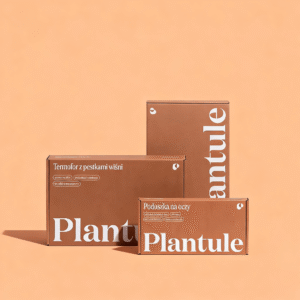
Folding cartons are the board you meet most often in retail. The stock is printed, die-cut, creased, and glued, and it arrives at your packing bench flat. Standard specifications run from 11 pt at 230 GSM up to 24 pt at 460 GSM, and the number you pick is a trade-off between shelf presence and cost.
Thicker board stands up straighter on a shelf and feels more substantial in the hand. It also costs more per unit, weighs more to ship, and takes up more space in storage. For a product that sits inside an outer shipper anyway, the extra thickness buys you very little. For a product that competes face-out next to five rivals, it buys attention.
Coated board takes colour better. Uncoated board takes texture better and recycles more cleanly, which is worth knowing if sustainability is part of your brief rather than an afterthought.
One practical note. The inside of a folding carton is a material decision too. Printing the inside face turns the open box into a second surface for artwork, which is common on cosmetics and confectionery. It costs more than a one-sided print, and whether it earns that cost depends entirely on whether anyone looks inside before the box goes in the bin.
Corrugated board is a different animal
Corrugated is not just thick paperboard. It is a sandwich: a fluted inner layer glued between two flat liners. That structure is why corrugated resists crushing in a way a solid board of the same weight cannot.
The letters describe the flute size. E-flute is the finer profile, thinner and smoother, so it prints well and folds neatly. B-flute is taller, which means more cushioning and more stacking strength, and a slightly rougher print surface. There is also double wall for genuinely heavy loads. If you are choosing between them, E-flute suits a branded mailer that goes straight to a customer, and B-flute suits anything that has to survive a parcel network.
What people usually get wrong is treating corrugated as a budget upgrade to paperboard. It is a different tool. If you need cushioning, corrugated wins outright. If you need a crisp, high-resolution print on a small box, a solid paperboard will beat corrugated every time, because the fluting shows through under print.
Rigid board, and the wrap that goes over it
Rigid boxes are built differently from the other two. The base is a thick board, typically 800 to 1,600 GSM grey chipboard, duplex board, or kraft, and it is not printed. Instead, it is wrapped in a printed or decorative material, and that wrap is what the customer actually sees and touches.
That is why a rigid box can take surfaces a folding carton cannot: metallic foil paper in gold, silver, or rose gold, holographic film, textured stock with a linen or soft-touch surface, and fabric or velvet. The board supplies the structure. The wrap supplies the impression. Once you understand that split, the pricing makes more sense, because you are paying for a wrapping step that is largely hand work.
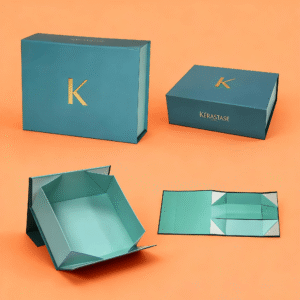
Rigid boxes also accept base materials that folding cartons do not, simply because of thickness. A 1,200 GSM board does not need a shipper to survive handling. It also does not fold, which is why rigid boxes either arrive pre-assembled or flat-folded using a collapsible structure. Pre-assembled is easier at the bench. Flat-folded stores in a fraction of the space, which usually matters more to a small operation than it does to a large one.
If you want to see how the wrap changes the whole character of a box, the custom rigid boxes page breaks the options down by material and finish rather than by structure.
Specialty stocks that change the print, not the structure
A category of materials sits on top of the standard board range and changes the surface without changing the engineering. Foil metallic cardstock, holographic stock, colored stock, and textured paper like Neenah are all paperboards with a treated face, and they let you get a dramatic result without adding a finishing step to every box.
Holographic stock is the one people underestimate. It reflects whatever light is nearby, so a design that looks flat on screen can look quite different in a shop. That is either the effect you want or a surprise you do not, and it is worth asking for a physical proof rather than approving from a screen.
Colored and textured stocks are often cheaper than achieving the same look with print plus lamination. If your brand colour is a strong single tone, a colored board can carry it with one ink instead of four.
The catch is minimums and availability. Specialty stocks come in a narrower range of thicknesses than standard board, so if your structure needs an unusual weight, the exotic surface may not be available in it.
Coatings and laminates are part of the material spec
Coating is where material choice quietly becomes a cost and a sustainability decision.
Lamination bonds a thin plastic film to the printed surface. It gives the strongest protection and the widest range of finishes, including soft-touch, which has a velvety feel that reads as premium immediately. Varnish and aqueous coating are applied as liquid and cured, and they are cheaper and lighter than lamination. Aqueous coating is water-based, which is why it gets used on packaging where the recycle story matters. Crystal UV and liquid UV give a high-gloss, hard-wearing surface.
The finish you pick also determines how the box ages. Anti-scratch coating exists specifically for boxes that get handled repeatedly and would otherwise show scuffs on a dark ink. Satin and pearlescent coatings sit between matte and gloss, and they are the ones that make a box look expensive without announcing it.
One trade-off worth stating plainly: plastic lamination gives the best protection and the worst recyclability profile. If a box is laminated, many kerbside streams will treat it as a mixed material. Uncoated or aqueous-coated board is the cleaner choice on that front, and it costs you some durability. There is no option that wins on both. Our board is FSC-certified under SGSHK-COC-330577, which is a chain-of-custody claim about the fibre itself and does not by itself make a laminated box recyclable.
Inserts: foam, cardboard, pulp, or PET trays
Whatever sits inside the box is also a material decision, and it is the one most often left to the last minute.
Foam is the classic choice for delicate or high-value items. It cuts cleanly to any shape, holds a product firmly, and absorbs impact, which matters for jewellery and electronics. It is the least recyclable of the common options.
Cardboard inserts are lighter and cheaper, and they suit multi-compartment layouts where the product needs organising rather than cushioning. Molded pulp is the option to pick if sustainability is driving the brief. It is made from recycled fibre, holds shape well, and goes into the same waste stream as the box.
Clear PET trays have one advantage the others do not: you can see the product through them. That is why they show up in presentation boxes across cosmetics and spirits, where the tray is doing part of the display work.
Dividers are the simplest insert and often the right answer for multi-item orders. They are cheap, they keep products from knocking together, and they do not add meaningful weight.
How to specify materials without paying for the wrong one
The most common expensive mistake is overspecifying the board and underspecifying the sample. A brand approves a 1,400 GSM board from a spec sheet, receives the production run, and discovers that the matte lamination they chose makes the dark navy look almost black. None of that shows up on a spreadsheet.
Two habits prevent most of it. First, ask for a physical swatch when the surface matters, because screens misrepresent coatings and specialty stocks badly. A swatch book will tell you more in ten seconds than a render will in an hour, and suppliers generally keep one available for exactly this.
Second, match the board to the job it does rather than to the price you hope it costs. A box that ships directly to a customer needs structure and scuff resistance. A box that sits on a shelf needs a sharp print face. A box that gets kept needs a wrap and a lining that still look good in a year. Those three jobs point at different materials, and the cheapest option for one is often the wrong material for another.
If you are not sure which combination fits your product, the most useful thing you can do is describe the product, the shipping route, and how you want the customer to feel when the box opens. Free design support is included with our custom packaging, and the quote form lets you specify materials, thickness, coating, and finishing up front, so the first response is a real specification rather than a question list.