
Rigid boxes vs folding cartons is really a question about three things: what you’re protecting, what the box is supposed to say about your brand, and how much you can spend per unit at the volume you actually order. Get those three answers sorted and the structure picks itself.
Here’s the short version. A rigid box is built on thick board and wrapped in printed paper, so it holds its shape and usually gets kept. A folding carton is printed paperboard that ships flat and folds into shape at the packing line, so it costs less per unit and takes less warehouse space. If the box is part of the product experience, go rigid. If the box is a container that gets recycled the same day, a folding carton is almost always the smarter buy.
That’s the decision in two sentences. The rest of this article is the reasoning behind it, including the cost drivers people usually miss.
The short answer, and when it flips
Most of the time the choice comes down to what happens to the box after it’s opened. If your customer photographs it, keeps it, or reuses it to store something else, that’s a rigid box job. If it goes straight into the recycling bin, you’re paying for durability nobody wanted.
There are two situations where that logic flips.
The first is freight. Rigid boxes are bulky. If you’re shipping your own product to customers, a rigid box inside a shipping carton means you’re paying to move air. Flat-folded rigid boxes solve part of that, and so do corrugated mailers, but the volume is still real.
The second is retail shelf. A folding carton with good print and a clean die-line can hold its own on a shelf next to a rigid box, at a fraction of the cost. Retail buyers rarely inspect the board weight. They look at the front panel from three feet away.
What each one actually is
Both get called “custom packaging,” which hides the fact that they’re different manufacturing processes with different economics.
Rigid boxes
A rigid box, sometimes called a set-up box, is built on heavy board, typically 800 to 1,600 GSM grey chipboard or duplex board, then wrapped in a printed paper, fabric, or specialty stock. The board gives it structure; the wrap gives it the finish. Common base materials include recycled grey chipboard, duplex board, SBS C1S or C2S paperboard, and kraft.
Because the board is thick, the box can be wrapped in materials a folding carton can’t handle well: velvet, linen-textured paper, metallic foil paper, holographic film. That’s the whole reason rigid boxes exist. You’re not buying a container, you’re buying a surface.
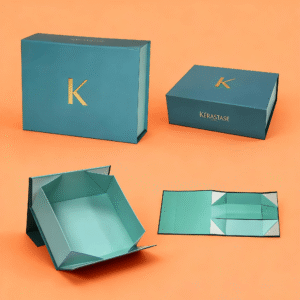
Rigid boxes can be delivered pre-assembled or flat-folded. Pre-assembled is simpler at the packing line. Flat-folded takes less space in storage and shipping, at the cost of a few seconds of assembly per unit.
Folding cartons
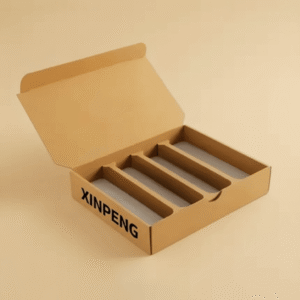
A folding carton is printed paperboard, commonly 11 pt to 24 pt (230 GSM to 460 GSM), that’s die-cut, creased, and glued so it can ship flat and be folded up when needed.
When you need cushioning rather than stiffness, the structure moves to corrugated board, and E-flute or B-flute become the relevant choices. Corrugated is still a folding carton in the sense that it ships flat and folds, but it behaves much more like a shipping container than a display piece.
So the material spread is the headline: roughly 230 to 460 GSM for a folding carton versus 800 to 1,600 GSM for a rigid box. That’s not a small difference, and it shows up in the quote.
Cost: where the money actually goes
Unit price comparisons between rigid and folding cartons are misleading unless you know what’s inside the number. Three things drive the gap.
Tooling and setup
Both structures need a die for cutting and creasing, so both carry a one-time tooling cost that gets amortized across your run. The difference is what happens after cutting. A folding carton comes off the line flat and glued, and that’s basically it. A rigid box has to be wrapped, which involves more manual handling per unit.
That’s why rigid quotes fall faster than carton quotes as volume rises, but start higher. If you’re ordering a few hundred units, the wrapping labor is a much bigger share of the unit price than it is at ten thousand.
Board and material
The material spread from the previous section is the second driver. Beyond GSM, the wrap matters. A rigid box wrapped in printed paper and one wrapped in fabric or metallic foil are the same structure at very different prices.
On the carton side, the choice between a standard white cardstock and a foil metallic or holographic stock moves the price more than most buyers expect, and coatings add on top.
Freight and storage
This is the line item people forget. Folding cartons ship and store flat, so you’re moving dense stacks of board rather than boxes full of air. Rigid boxes take volume, whether you’re storing them or shipping them to a fulfillment center.
Run the numbers on landed cost, not unit cost. A slightly higher carton price with a much smaller shipping volume can beat a cheaper rigid quote once freight is in.
Protection, weight, and what happens in transit
Rigid boxes resist dents and hold their shape under pressure. That makes them the right call for heavier or fragile items, especially when paired with an insert: die-cut foam, molded pulp, cardboard, or PET trays, plus dividers when you’re packing multiple pieces.
Where rigid boxes earn their keep is when the box itself is the shipping package. Think a magnetic closure box with a foam insert going straight into a courier bag. Fewer layers, less damage, and the customer opens the actual product packaging.
Folding cartons handle light products well. Cosmetics, supplements, tea, confectionery, small electronics accessories: the box holds the item and carries the print, and the protection comes from an outer shipper. That’s a normal, efficient setup. It only breaks down when the product is heavy enough to crush the carton or sharp enough to tear a corner.
If your product is fragile and you’re shipping it yourself, test both. Order a sample of each, pack it the way you actually pack, and drop-test it. That’s a cheaper experiment than a reprint.
Unboxing and perceived value
Rigid boxes change how a product feels. The lid lifts cleanly, the weight is noticeable, and the box survives the first week instead of going into the bin. Magnetic closures, ribbons and pull tabs, satin linings, foil edging: all of that is available on rigid structures in a way it isn’t on paperboard.
That matters most for products where the purchase is partly emotional: jewelry, candles, fragrance, premium chocolate, gift sets. It also matters for brands selling direct, where the unboxing is the only physical brand moment a customer gets.
What rigid boxes don’t do is sell a product that isn’t good. A beautiful box raises expectations, and if the product inside doesn’t meet them, the disappointment lands harder. Spending more on the box than on the product is a common way to get the order of priorities backwards.
Folding cartons can still look excellent. A well-designed carton with spot UV and a soft-touch coating reads as premium on a shelf. It just doesn’t survive being kept, and it doesn’t carry the same physical weight in the hand.
Sustainability: what actually gets recycled
Both structures are paper-based, and paper packaging is widely recyclable. The complication isn’t the box, it’s everything attached to it.
Lamination films, some wraps, foam inserts, PET trays, magnetic closures, and ribbon handles all change whether a pack can go into a single recycling stream. A rigid box wrapped in paper with a molded pulp insert and no plastic is straightforward. The same box with a laminated wrap and a foam insert isn’t, even if the box itself is board.
If sustainability is part of why you’re choosing a structure, ask your supplier for the material breakdown, not the marketing line. Two things worth checking: whether the board is FSC-certified, and whether the inserts are molded pulp or plastic. Xin Peng’s board is FSC-certified under SGSHK-COC-330577, and both kraft and molded pulp insert options are available if that’s where your brief is heading.
A pack can also be mostly recyclable and still fail a kerbside test because of one component. Ask which single part would disqualify yours, then decide whether it’s worth swapping.
Printing and finishing: what each structure handles well
Folding cartons suit high-volume print. Offset for quality at volume, flexographic for economical long runs, digital for short runs and versioning. The flat sheet prints predictably and the waste rate is low.
Rigid boxes give you more surface to work with. Because the box is wrapped, you can use metallic foil paper, textured stock, fabric, or velvet. On top of that, hot foil stamping, embossing and debossing, spot UV, die-cut windows, and foil edging all work well. That’s how you get a box that feels expensive before anyone reads the label.
Coatings apply to both: matte, gloss, soft-touch, aqueous, anti-scratch, satin, pearlescent. If you’re undecided there, the practical question is whether the box will be handled a lot in transit. Anti-scratch and soft-touch earn their cost on rigid boxes that travel as the outer pack.
On cartons, gloss and matte coatings are usually a print-quality decision rather than a durability one, because the outer shipper absorbs the wear instead.
The comparison, side by side
| Rigid box | Folding carton | |
|---|---|---|
| Board weight | 800–1,600 GSM grey chipboard, duplex board | 11–24 pt (230–460 GSM) paperboard; E-flute or B-flute corrugated when cushioning is needed |
| Ships | Pre-assembled or flat-folded; takes volume | Flat; dense and space-efficient |
| Unit cost | Higher; improves with volume as wrapping labor amortizes | Lower; scales well at high volume |
| Structure | Holds shape, resists dents | Folds into shape; needs outer shipper |
| Best for | High-value, fragile, giftable, direct-to-consumer unboxing | Retail shelf, light products, high-volume runs |
| Finishing | Foil, embossing, spot UV, foil edging, fabric and velvet wraps | Offset, flexo, digital print; spot UV, coatings |
| After opening | Often kept | Usually recycled |
How to decide in four questions
- Will the customer keep the box? Yes means rigid. No means folding carton.
- Is the box also the shipping package? Yes means rigid with an insert, or a corrugated mailer. No means folding carton plus an outer shipper.
- What’s your order volume? A few hundred units means compare landed cost carefully, because tooling weighs more. Thousands and up and folding carton pricing gets much better.
- Does the product need a surface a carton can’t give it? Fabric, velvet, foil wrap, deep embossing means rigid.
If you answer “rigid” to the first and third questions and the budget still closes, stop deliberating. If the answers conflict, get quotes on both and compare landed cost. For most brands the decision takes one afternoon and saves a reprint.
FAQ
Can a folding carton look as premium as a rigid box?
On a shelf, often yes: quality print, spot UV and a soft-touch coating go a long way. In the hand, no. A carton lacks the weight and structural rigidity, and it does not survive being kept.
Which is cheaper for small orders?
Folding cartons, usually. Rigid boxes carry more per-unit labor in the wrapping stage, which hits small runs hardest. That gap narrows as volume grows.
Do rigid boxes cost more to ship?
They take more volume, so yes if you are shipping them. Flat-folded rigid boxes reduce this, and the trade-off is a little assembly time when you pack.
Can I get samples before committing?
Yes, and for a structural decision like this you should. Ask for a sample of each structure in the board and finish you are considering, then pack and handle them the way your customers will. A swatch book also helps if you are still choosing materials.
Do both options work for eco-focused brands?
Both are paper-based and recyclable in principle. What decides it is the wrap and the insert. Uncoated or lightly coated board with molded pulp inserts is the cleanest combination.
Are the orders printed with my own artwork?
Yes. Free design support is included, and files go through a pre-press check before production so print-ready artwork issues get caught before the run.
Next step
If you’re leaning rigid, start with the material and wrap rather than the shape, because those two choices move the cost and the feel more than anything else. You can browse custom rigid boxes and magnetic closure boxes to see the range, or look at folding carton styles if your volume and shelf strategy point the other way.
Still torn? Send us the product, the volume, and the deadline, and we’ll quote both structures side by side so you can compare landed cost instead of guessing. You can also request a quote directly.
When you send the brief, include the product dimensions, the packed weight, your target quantity, and whether the box ships on its own or inside an outer carton. Those four details are what let a supplier quote both structures accurately on the first pass, instead of coming back with a round of questions that costs you a week.