
The box that works for a two-person candle brand is not the box that works for a thirty-person skincare company, even when they sell the same kind of thing. Volume decides almost everything else. It decides which structures you can afford, how much tooling you can spread across a run, and whether the box has to survive a courier network or just a shelf.
So there isn’t one answer. There are four styles a small brand will realistically choose from, and the right one depends on what you are shipping, how many units you can commit to, and whether the box is doing the selling or only the protecting.
Mailer boxes are usually the safest first order
If you sell online and ship direct to customers, a corrugated mailer is the least risky place to start. It folds flat, so you are not paying to warehouse air. It takes a knock without crushing what’s inside. And unlike a rigid box, it can go into the post on its own, which means one layer of packaging instead of two.
For lightweight products, an E-flute mailer is usually enough. E-flute is thin corrugated board, so it stays light and letterbox-friendly while still holding a printed surface well. If your product has any weight to it, or the box has to travel through a courier network with other parcels landing on it, a heavier flute is worth the small cost difference.
The reason mailers suit small brands is the print. Because the outside is a flat sheet, you can print a full-colour design across the whole panel instead of settling for a logo stamp. That is where a small brand gets its money’s worth: one box, fully branded, no extra label or sticker needed.
Take a look at the custom mailer box options if you want to see how the structures differ, but the practical starting question is simpler than that. Will the box be handed to a customer in person, or will it be thrown in a van? If it’s the van, start here.
Folding cartons make sense once you’re on a shelf
A folding carton is printed paperboard, usually somewhere between 11 pt and 24 pt, which is about 230 to 460 GSM. It ships flat, gets folded up at the packing bench, and it is the cheapest structure per unit once your volumes climb. For a retail product that sits next to competitors on a shelf, it is often the correct answer.
What a carton does well is carry artwork. Cosmetics, supplements, tea, confectionery, small accessories: the box holds the product, the front panel does the talking, and protection comes from an outer shipper. That’s a normal and efficient setup. It only fails when the product is heavy enough to crush the board or sharp enough to tear a corner.
The trade-off small brands notice is that a carton doesn’t survive being kept. It goes into the recycling the same day. If your customer photographs the unboxing or stores the box afterwards, a carton is the wrong structure no matter how good the print looks.
There’s also a middle path worth knowing about. If you need cushioning rather than stiffness, you move to corrugated board, and the choice between E-flute and B-flute becomes the relevant decision. Both are still folding cartons in the sense that they ship flat, but they behave much more like a shipping container than a display piece.
Rigid boxes are worth it when someone keeps the box
Rigid boxes are built on heavy board, commonly 800 to 1,600 GSM grey chipboard or duplex board, then wrapped in a printed paper, fabric, or specialty stock. The board provides the structure and the wrap provides the finish, which is why a rigid box can take materials a folding carton cannot: velvet, linen-textured paper, metallic foil, soft-touch film.
That thickness is also why rigid boxes cost more. A carton comes off the line flat and glued and that’s the end of it. A rigid box has to be wrapped, and wrapping is hand work, which hits small runs hardest. The gap narrows as volume grows, but it never disappears.
For a small business, the question is whether the box is part of the product. For jewellery, fragrance, candles at the higher end, chocolate, or gift sets, it usually is. Customers keep those boxes, and a kept box keeps working for you on a shelf somewhere else. If the box goes straight into the bin, you have paid for durability nobody wanted.
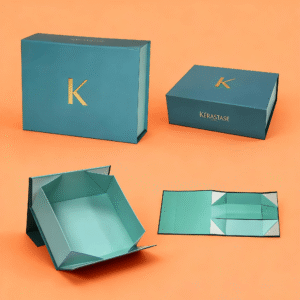
Rigid boxes can arrive pre-assembled or flat-folded. Pre-assembled is simpler at the packing bench. Flat-folded takes a fraction of the storage space, which matters a lot when you are working out of a small unit and your stock arrives three weeks before your busy season.
Kraft packaging is the cheapest way to look intentional
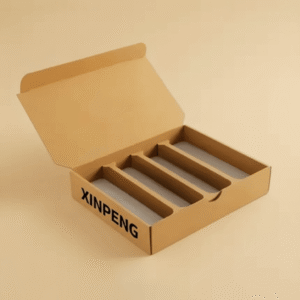
Kraft gets treated as the budget option, which undersells it. Uncoated brown kraft board has a natural, earthy surface and it reads as a deliberate choice rather than a compromise, especially for organic products, coffee, candles, and anything positioned as low-waste.
From a small brand’s point of view, kraft does three useful things at once. It costs less than coated white board. It hides scuffs better, so a box that gets handled a lot doesn’t look tired. And it pairs naturally with one-colour or two-colour printing, which keeps the print bill down because you are not paying for heavy process work.
The mistake is assuming kraft means plain. Single-colour printing on brown kraft with a well-set logo is one of the cleaner looks in packaging, and it doesn’t need lamination or foil to work. If you want to see how that lands in practice, the kraft box range shows the difference between natural kraft and kraft-look white or black stocks.
One note on sustainability claims, since kraft and eco messaging get mixed together constantly. Paper-based packaging is widely recyclable, but the coating and the insert decide whether your specific pack makes it through a kerbside stream. If a supplier’s board is FSC-certified, that is a chain-of-custody claim about the fibre, not a claim that the whole box is recyclable. Ours is certified under SGSHK-COC-330577, and it is worth asking what that certificate actually covers before you put a recycling logo on the box.
Where small brands usually overspend
The first overspend is tooling spread over too few units. Every structure needs a die for cutting and creasing, and that cost is fixed whether you order five hundred boxes or fifty thousand. Ordering the minimum on a complex structure means paying the setup twice when you reorder. Ordering one size that covers several products is usually smarter than ordering three sizes well.
The second is the finish stack. Foil stamping, embossing, spot UV, soft-touch lamination, foil edging: each one adds a step, and each step has its own setup. A small brand that wants to look premium often buys four finishes when one would have carried the design. Matte lamination with a single spot UV logo will read as premium and cost a fraction of foil plus emboss plus soft touch.
The third is over-engineering the structure. A magnetic closure rigid box is a beautiful object, but if your product goes into a shipping carton anyway, the magnet is paying for something your customer never experiences. Save the rigid box for the products where the unboxing is the moment.
How to keep minimums manageable
Minimum order quantities are set per style, not per company. A standard kraft mailer in an existing size can start far lower than a magnetic closure rigid box, because the rigid box needs more tooling and more hand assembly. So ask for the minimum on the exact structure you want rather than reading a number off a general page.
There are two levers that genuinely reduce the barrier for a first order. Digital printing keeps setup low, which makes short runs viable, where offset printing only starts to pay off once you are printing thousands. And we credit the cost of samples against a first order placed within 30 days, which turns sampling into a de-risked step rather than a sunk cost.
If you are unsure which structure fits, ask for samples before you commit to a run. Holding two options side by side answers questions that no amount of catalogue browsing will.
Artwork problems that cost you a reprint
Almost every reprint traces back to the same short list of artwork problems, and none of it is about design talent.
Dielines get ignored. The dieline is the template that shows where the box folds and cuts. Artwork placed over a fold line will crack or land in the wrong place once the box is formed.
Bleed gets left off. Printed artwork needs to extend past the trim line, otherwise a small shift in cutting leaves a white sliver along the edge. It is a millimetre-level problem that becomes visible on every single box.
Colours get sent as RGB. Screens and presses do not describe colour the same way. Print files belong in CMYK for process work, or as a Pantone reference when you need a brand colour to match exactly across orders and materials.
Fonts get left unembedded or un-outlined. If a printer has to substitute a font, your layout shifts, and the file comes back for approval a second time.
None of this is hard to get right, and most of it is avoidable by asking your supplier for their dieline and file specification before you start designing rather than after.
Questions small brands ask before their first order
Do I need to order thousands of boxes to start?
No, but the minimum depends on the structure. Simple folding cartons and mailers have far lower entry points than wrapped rigid boxes. Ask for the minimum on the specific style you want.
Can a small brand get help with the design?
Free design support is standard with most custom box suppliers, and it usually covers checking your artwork and adapting it to the dieline. You keep creative control, and they make sure the file is print-ready.
What if I choose the wrong box?
That is what samples are for. Ask for the structures you are considering in the board and finish you would actually order, pack one the way you pack for real, and handle it the way a customer will. It costs far less than a reprint.
If you are still weighing structures, send over the product, the quantity you can commit to, and your deadline. Quoting two options side by side is the quickest way to see where the money actually goes, and you can request a quote whenever you’re ready.